
Vinegar vs. Bleach: When to Use Each Cleaner (A Food Scientist Explains the Science)
Can vinegar really disinfect? Is bleach always better? And why does bleach have EPA approval while vinegar doesn't? Let's explore the science behind two of the most common with a family-friendly, realistic rhythm for busy homes.
- Article details
- By Sharon Nissley6 min readUpdated
Article contents
Contains Affiliate Links.
Can vinegar really disinfect? Is bleach always better? And why does bleach have EPA approval while vinegar doesn't? Let's explore the science behind two of the most common household cleaners.
Quick Answer
If you're short on time, here's the takeaway:
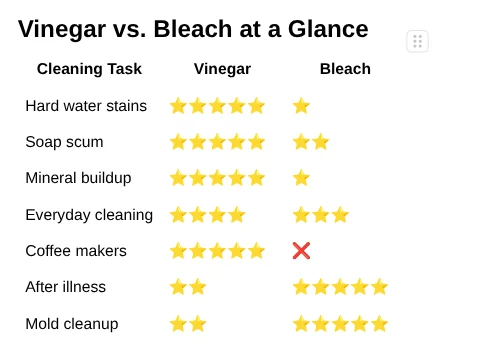
- Use vinegar for hard water stains, mineral buildup, soap scum, coffee makers, shower doors, and everyday cleaning.
- Use bleach when reliable disinfection is needed, such as after illness, mold cleanup, or contamination.
- Vinegar has antimicrobial properties, but it is not an EPA-registered disinfectant.
- Never mix vinegar and bleach.
Now let's look at why.
Why I Started Researching This
Bleach and vinegar are two of the most common cleaning products in American homes. Both are inexpensive, both have been used for generations, and both are recommended for a surprising number of cleaning jobs.
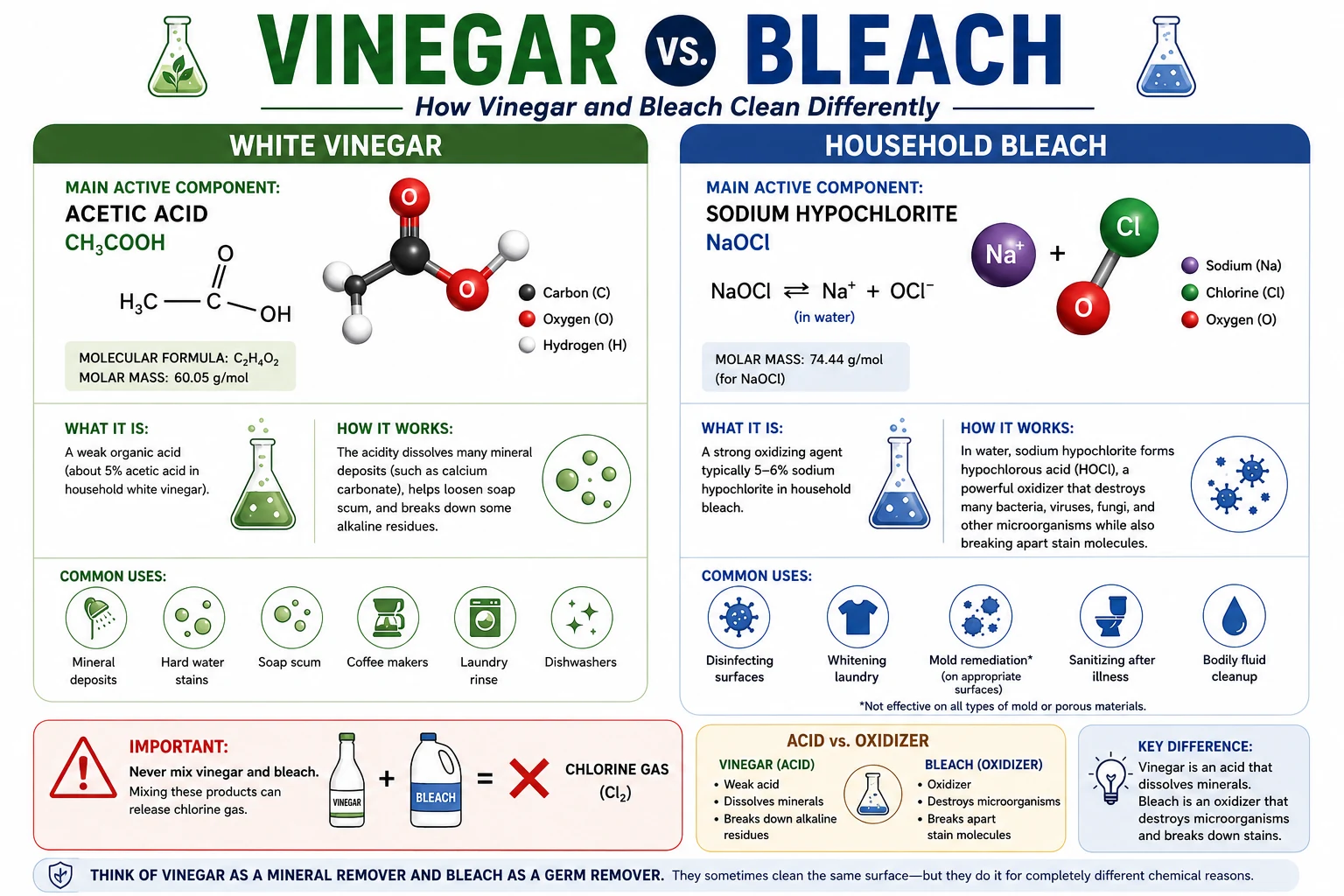
Vinegar is an acid. Bleach is a base. Since they sit on opposite ends of the pH scale, I found myself wondering: When is vinegar actually the better choice, and when is bleach the better choice?
As someone with a degree in Food Science who enjoys understanding the "why" behind things and then explaining that science to my kids in a homeschool-friendly way I decided to dig a little deeper.
I'll also admit that I naturally reach for vinegar first whenever possible. We live on a farmette with our own well and septic system, so I'm always mindful that what goes down the drain doesn't simply disappear. That doesn't mean bleach never has a place in our home, but I like understanding where each product shines so I can make thoughtful decisions.
Vinegar vs. Bleach in One Sentence
If you remember only one thing from this article, remember this:
Vinegar changes the environment. Bleach attacks the microbe.
That one sentence explains most of the difference.
How Vinegar Works
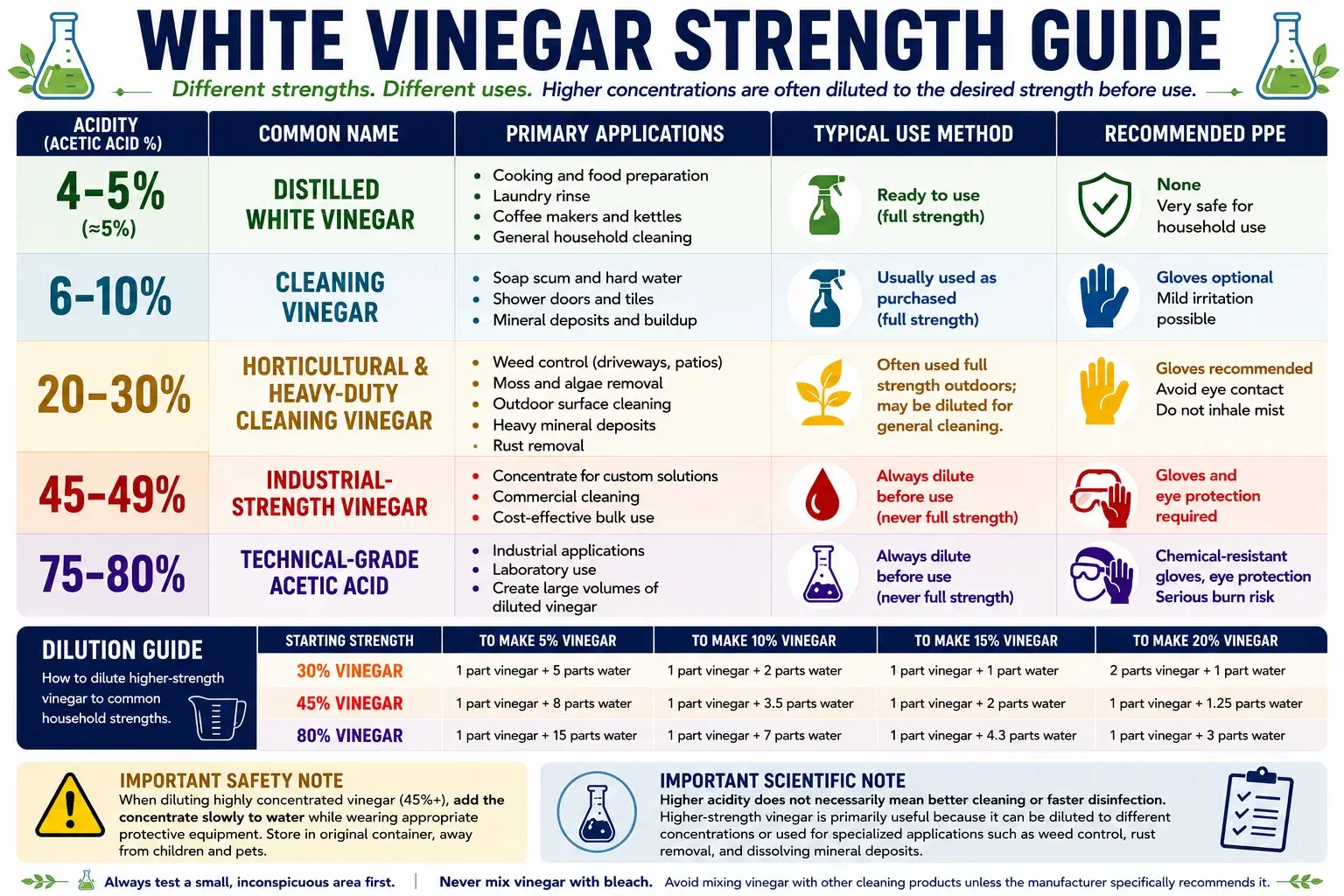
Household distilled white vinegar is typically about 5% acetic acid, while cleaning vinegar is often around 6%.
Its acidity helps dissolve mineral deposits, remove hard water stains, break down soap scum, and create an environment where many microbes struggle to survive.
Humans have relied on acidic environments for thousands of years. Pickles, sauerkraut, yogurt, kefir, kombucha, and sourdough all depend, at least in part, on acidity to help control undesirable microbes.
So when someone says vinegar has antimicrobial properties, they're absolutely right.
The real question isn't whether vinegar works. The question is how well it works against different microbes under different conditions.
There are actually quite a few "white vinegars” on the market, basically different dilutions. I never realized I could buy various dilutions. See the concentration guide below:
How Bleach Works
Bleach works very differently. Instead of changing the environment, bleach is a powerful oxidizer. It damages bacteria, viruses, mold, and fungi by attacking proteins, enzymes, cell membranes, and genetic material. Because bleach disrupts several critical systems at the same time, it generally works much faster than vinegar.
That's why bleach is commonly used when reliable disinfection is the goal.
Does Vinegar Kill Germs?
Yes—but this is where the science becomes more nuanced.
We know acidity affects microbes. We know acetic acid can inhibit or damage certain bacteria. We know vinegar has antimicrobial activity.
What we don't know with the same level of confidence is exactly how household vinegar performs against every pathogen, on every surface, under every real-world condition.
Different microbes respond differently to acidity. Many foodborne bacteria struggle in acidic environments, while some viruses are much more resistant. Norovirus, for example, is famous for surviving conditions that destroy many other microorganisms.
What I found especially interesting is that this shouldn't really surprise us. Humans have relied on acidic environments to help control microbes for thousands of years. Acidity affecting microbes isn't a new discovery—it's simply something we've understood through food preservation long before modern disinfectants existed.
So the better question isn't "Does vinegar work?"
It's "Which microbes? At what concentration? For how long?"
The EPA Is Kind of Like the FDA for Cleaning Products
This was one of the most interesting parts of my research.
Most of us are familiar with the FDA. If a pharmaceutical company wants to claim that a medication treats a disease, it has to provide evidence supporting that claim.
The EPA plays a similar role for disinfectant claims.
If a company wants to market a cleaner as a disinfectant—making claims like "Kills 99.9% of bacteria in 5 minutes"—it must submit standardized testing showing the product performs as advertised.
One thing that helped me think about it was this: the FDA doesn't simply decide whether a medicine "works," and the EPA doesn't simply decide whether a cleaner "works." Both agencies evaluate the evidence companies submit so they can legally make specific claims.
Bleach has gone through that process. Household vinegar has not. At first glance, that sounds like bleach wins and vinegar loses. But I don't think it's quite that simple.
Vinegar is inexpensive, widely available, and difficult for any one company to profit from. If one manufacturer spent millions of dollars proving ordinary vinegar met EPA disinfectant standards, every other vinegar company could potentially benefit from that research.
As a result, there has been much less financial incentive to build the extensive testing package required for EPA registration. That doesn't prove vinegar is ineffective, it just hasn't gone through the same standardized testing required to make EPA disinfectant claims. Those are two very different statements.
This reminds me of dietary supplements. Many supplements have promising research or long histories of use, yet they don't go through the same approval process as prescription medications. That doesn't automatically mean they're ineffective—but it also doesn't mean they should make claims that haven't been rigorously tested.
For me, that's one of the biggest lessons from this topic.
Science isn't just about asking "Does it work?"It's also about asking "What kind of evidence are we looking at?"and probably some politics and profit shares.
My Cleaning Philosophy
After researching all of this, I don't think vinegar and bleach are competitors. I think they're different tools for different jobs.
Around our farmette, I reach for vinegar first whenever it makes sense. It works wonderfully for mineral buildup, hard water stains, soap scum, coffee makers, and everyday cleaning, and I appreciate being thoughtful about what enters our septic system and eventually our land.
At the same time, I don't hesitate to use bleach—or another EPA-registered disinfectant—when I need a higher level of confidence that a surface has been disinfected, such as after illness, mold cleanup.
Frequently Asked Questions
Is vinegar a disinfectant?Not in the regulatory sense. Vinegar has antimicrobial properties but is not an EPA-registered disinfectant.
Can vinegar replace bleach?Sometimes. Vinegar is excellent for many everyday cleaning jobs. For situations involving illness or significant contamination, bleach or another EPA-registered disinfectant generally provides greater confidence.
Why isn't vinegar EPA-approved?Household vinegar hasn't gone through the extensive standardized testing required to legally market it as a disinfectant. That doesn't prove it lacks antimicrobial activity—it simply means it cannot make the same verified disinfectant claims as registered products.
Key Takeaways
- Vinegar and bleach are different tools for different jobs.
- Vinegar works primarily through acidity.
- Bleach works primarily through oxidation.
- Vinegar has antimicrobial properties but is not an EPA-registered disinfectant.
- Bleach has standardized testing supporting its disinfectant claims.
- Understanding how evidence is gathered is just as important as understanding what the evidence says.