Naptime Village Recipe
Sweet potato chocolate chip toffee sourdough boule with a tender crumb, golden crust, chocolate pockets, and overnight cold proof.
Prep
45 mins active (+ overnight cold proof)
Cook
40-45 mins
Total
18-24 hrs
Serves
12 slices
Difficulty
Easy
Calories
295 kcal
Protein
12.4 g
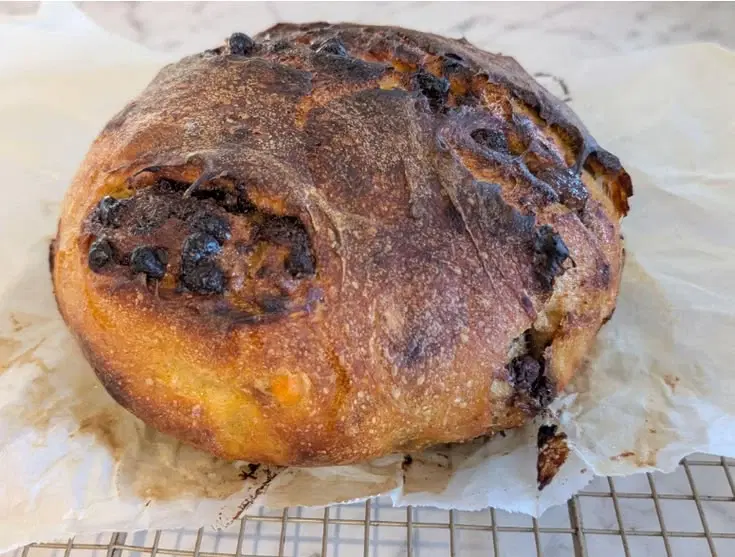
An artisan sourdough that reads like breakfast toast: roasted sweet potato adds tenderness and color, while chocolate chips and toffee bring caramel notes. Build dough strength first, then laminate the inclusions so the loaf stays cohesive. Sourdough fermentation keeps sweetness balanced, and an overnight chill makes scoring clean and oven spring strong.
This dough carries extra moisture and sugar from roasted sweet potato and inclusions. That combination softens gluten and weighs down the network, so you must front-load strength (autolyse + initial mixing/folds) and delay inclusions until the dough is elastic. Cold proofing increases dough extensibility and tones down stickiness from melted sugars, which helps with scoring and oven spring.
Score interpretation: This recipe leans treat-forward. Fermentation and sweet potato contribute structure and some phytonutrients, while chocolate and toffee tilt it toward an occasional bake. Metabolic and inflammation perspectives are closer to neutral than the overall balance, which flags more caution because of refined flour and added sugars.
Ingredients
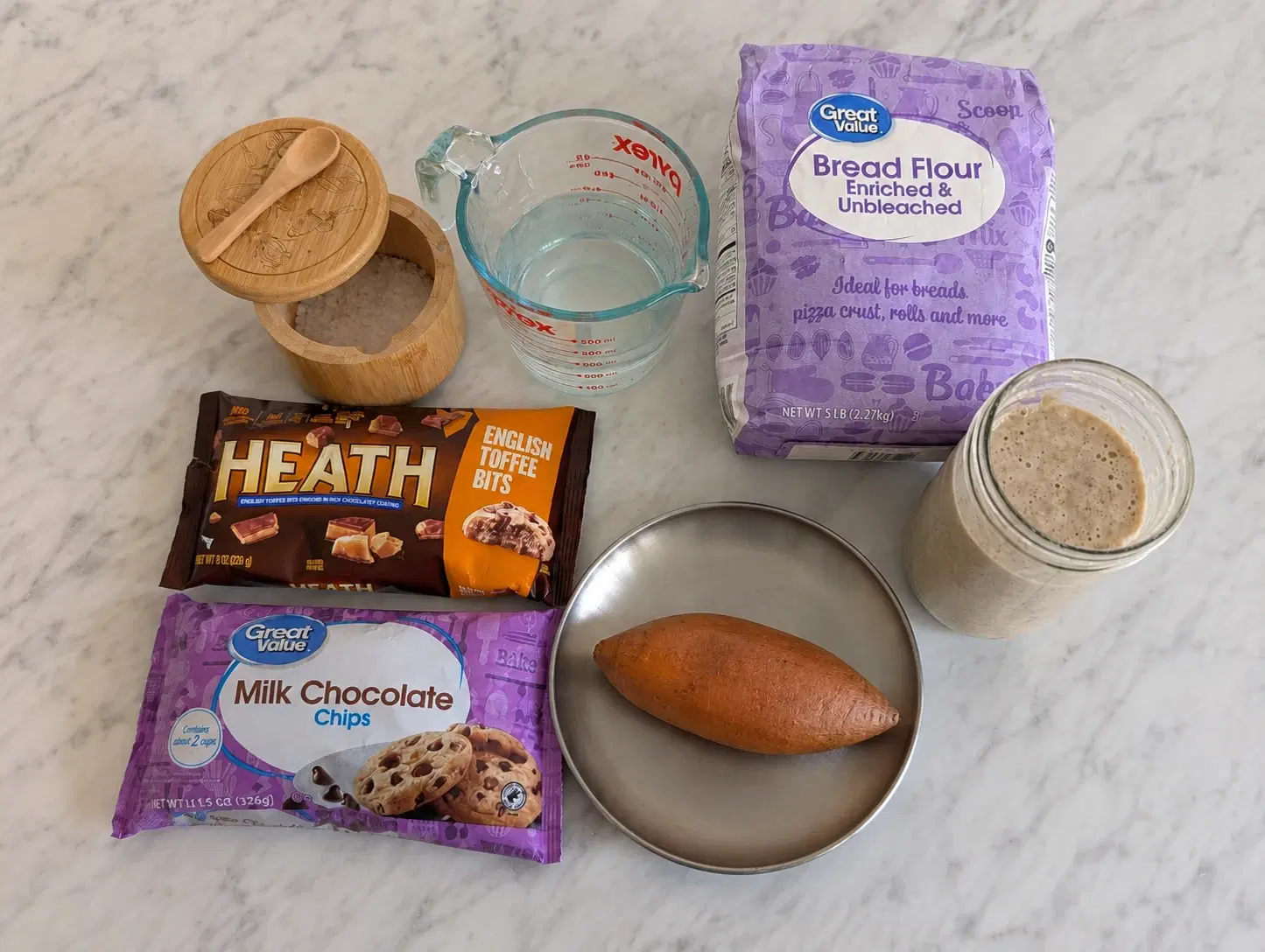
Bench scraper
KitchenAid stand mixer (or sturdy bowl for hand mixing)
Parchment paper
Ingredient notes
Use active sourdough starter at or near peak for best fermentation strength.
Bread flour gives the dough enough structure to support sweet potato, chocolate, and toffee.
Heath toffee bits melt into caramel-like pockets; chopped toffee bars can work if the pieces are small.
Chocolate chips hold their shape better than chopped chocolate during lamination and baking.
Roast and cool the sweet potato
Roast the sweet potato until very soft and slightly caramelized, then mash or puree until smooth and let it cool completely before mixing the dough.
Autolyse
Mix the flour, water, and sweet potato until combined. Rest 30 minutes, or up to 45 minutes if using the stretch-and-fold method.
Add starter and salt
Add the starter and salt to the autolysed dough. For the mixer method, mix on speed 2 for 5 to 6 minutes until smooth and elastic. For the hand method, mix thoroughly by hand until the dough comes together.
Build dough strength
If using the mixer, let the dough begin bulk fermentation and watch for a 20 to 30 percent rise over about 2 to 3 hours. If using stretch-and-folds, perform 4 sets every 30 minutes over 2 hours, then continue until the dough looks slightly airy.
Laminate the inclusions
Turn the dough onto the counter and stretch it thin. Scatter the chocolate chips and toffee bits over the dough, leaving a small clean border around the edges, then fold it into a parcel.
Finish bulk fermentation
Return the dough to the bowl and continue fermenting until the total rise reaches about 40 to 50 percent and the dough looks puffy and cohesive.
Pre-shape
Turn the dough out, shape it into a loose round, and let it rest for 15 minutes.
Final shape and cold proof
Shape into a tight boule and place seam-side up in a floured banneton. Refrigerate 12 to 14 hours overnight.
Preheat the oven
Preheat the oven with the Dutch oven inside to 450°F for 45 minutes.
Bake
Transfer the loaf to parchment, score, and bake covered for 20 minutes at 450°F. Remove the lid and bake 20 to 25 minutes more at 425°F. Lower to 415°F if the loaf is browning too fast.
Cool before slicing
Cool for 1 to 2 hours before slicing. Aim for an internal temperature of 205 to 208°F.
The rest after lamination matters because the dough needs time to re-knit around the chocolate and toffee before shaping.
Per-serving details
Calories
295 kcal
Protein
12.4 g
Carbs
50.3 g
Fat
6.8 g
Nutrition information is automatically calculated, so should only be used as an approximation.
Coffee or tea for a warm, slightly bitter counterpoint to caramel notes
Cold milk for a classic pairing with chocolate
Greek yogurt and berries to add tang, protein, and freshness beside a sweet slice
Keep this recipe handy
Tips, variations, storage advice, and quick fixes—all in one place.
Store wrapped at room temperature for 1 to 2 days.
For longer storage, slice and freeze with parchment between slices for up to 2 months.
Reheat slices in a toaster or 350 F oven until warm.
Because of the chocolate and toffee, this loaf has the best crust-and-crumb contrast on the first day.
If the loaf separates into layers, it likely needed more fermentation time after lamination.
If the crust browns too fast, reduce the uncovered bake temperature to 415 F.
If the dough feels weak, check that the sweet potato was not too wet and that the starter was fully active.
If the loaf spreads after scoring, it may be overproofed or shaped without enough surface tension.
If the crumb seems gummy, cool the loaf longer before slicing and confirm the center reached 205 to 208 F.
Can I use sourdough discard instead of active starter?
This recipe needs active sourdough starter for structure and rise. Discard alone is not strong enough unless it has been recently fed and is actively rising.
When should I add chocolate chips and toffee to sourdough?
Add them after the dough has built strength and started bulk fermentation. Laminating them in later helps the dough stay cohesive and keeps the inclusions evenly distributed.
Why did my sourdough boule separate into layers?
Layering usually happens when inclusions are added before the dough has enough strength or when the dough does not ferment enough after lamination.
Can I freeze sweet potato chocolate chip sourdough?
Yes. Slice the cooled loaf, freeze with parchment between slices, and reheat slices in a toaster or oven until warm.
How long should this loaf cool before slicing?
Let it cool for 1 to 2 hours. The sweet potato crumb and melted chocolate need time to set so the slices cut cleanly.
See what other cooks think and share your own tips.
Want to leave a review?
Sign in with your account to rate this recipe and share your notes.
Loading reviews…