
Baking Soda vs. Borax: What's the Difference (and Which One Should You Use?)
As I've scrolled through social media, I've seen countless influencers recommending baking soda and borax for everything from homemade laundry detergent to all purpose cleaners. with a family-friendly, realistic rhythm for busy homes.
- Article details
- By Sharon Nissley7 min readUpdated
Article contents
Contains Affiliate Links
As I've scrolled through social media, I've seen countless influencers recommending baking soda and borax for everything from homemade laundry detergent to all-purpose cleaners. Both products have been around for generations, and it's easy to assume that because our great-great-grandparents used them, they must automatically be better than today's commercial cleaners.
While I knew they weren't exactly the same thing, I didn’t fully understand why you would choose one over the other.
As someone who tends to live somewhere between the crunchy and conventional worlds, I love learning from previous generations. They often found wonderfully simple solutions long before grocery store shelves were lined with specialty cleaning products.
But history also teaches us something important. Just because something has been used for a long time doesn't automatically make it the best choice for every situation. Modern chemistry helps us understand why these products work, where they shine, and when a little caution is appropriate.
Let's take a look at two cleaning closet classics that absolutely deserve a place in many homes—but for different reasons.
Mom Science Minute: Why Do Both Clean?
Both baking soda and borax are bases, meaning they have a pH above 7 on the pH scale.
If you read my Vinegar vs. Bleach article, you'll remember that acidic and alkaline cleaners each have different strengths. Vinegar excels at dissolving mineral deposits, while alkaline cleaners are generally better at breaking down grease, body oils, sweat, and many food stains.
Both baking soda and borax fall into the alkaline category. The important difference is that they don't have the same "personality." Think of baking soda as your gentle everyday helper and borax as the heavy-duty assistant you call in when the job gets tougher.
The Chemistry Behind the Cleaning
Although they look nearly identical to the naked eye, they're completely different compounds.
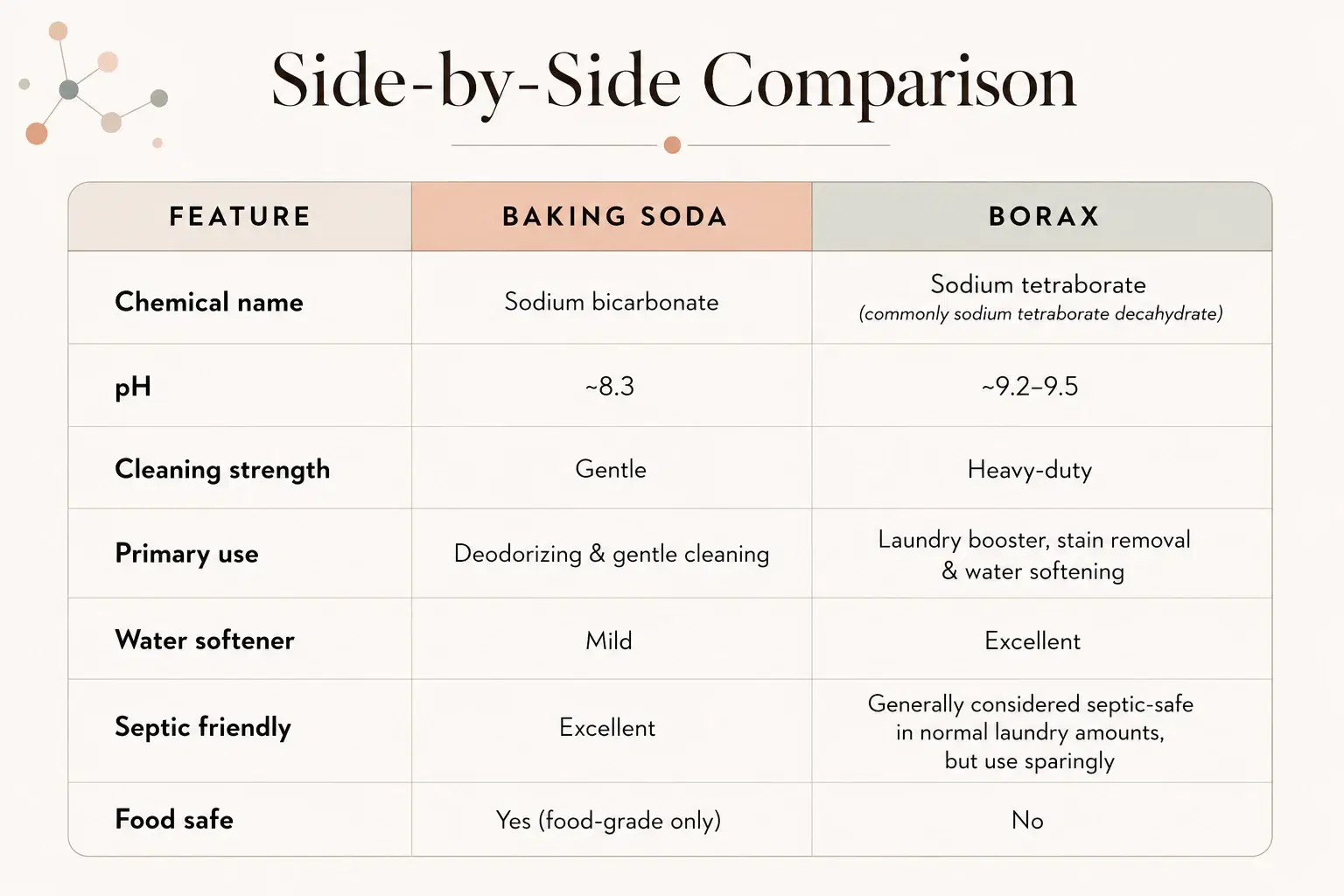
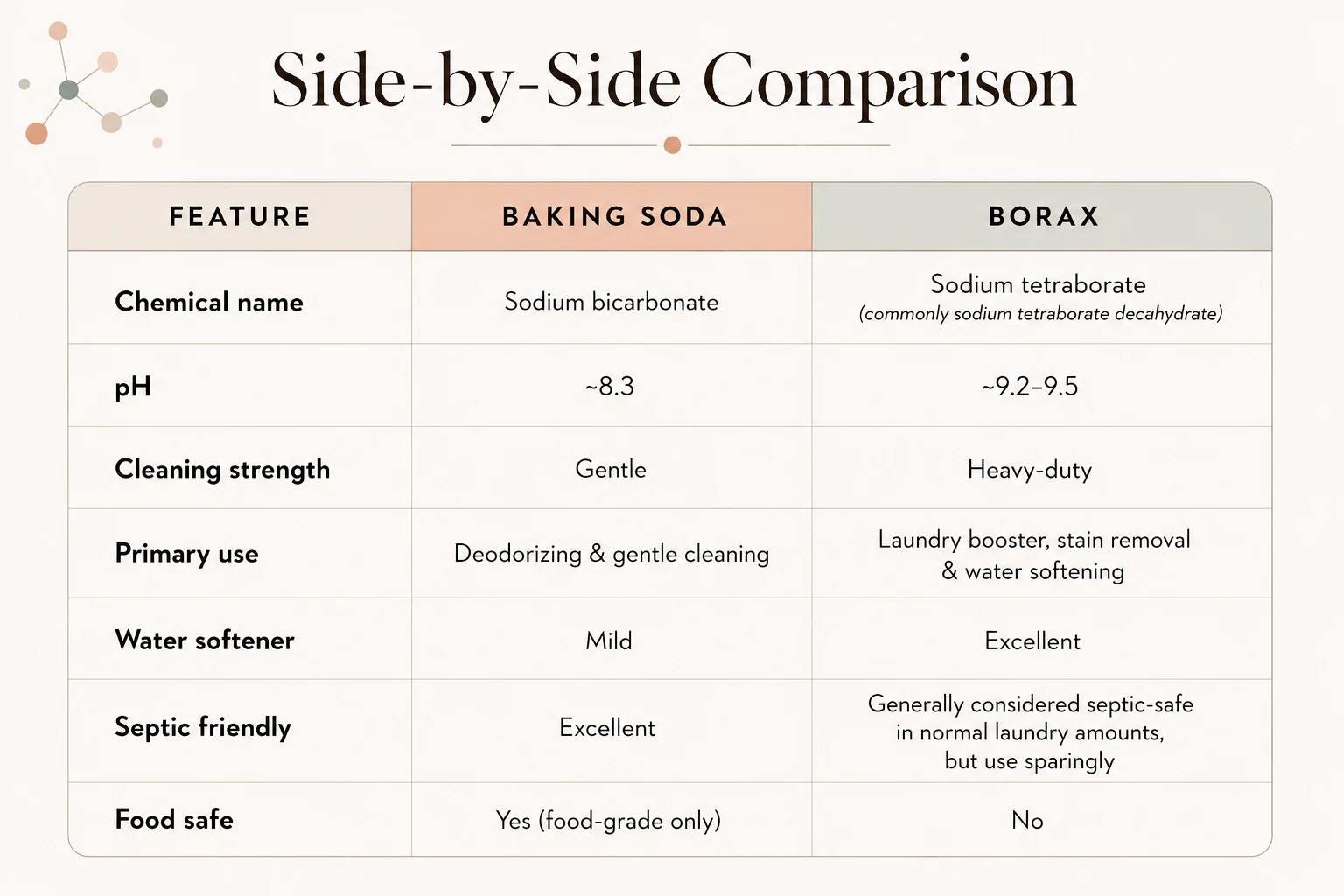
Baking soda is sodium bicarbonate (NaHCO₃). With a pH of about 8, it's a mild alkaline cleaner that's gentle enough to bake with, safe around food, and excellent at neutralizing odors.
Borax is sodium tetraborate decahydrate (Na₂B₄O₇·10H₂O). It has a pH of about 9.5. That may not sound like much of a difference, but because the pH scale is logarithmic, borax is roughly 30 times more alkaline than baking soda based on pH.
That extra alkalinity makes borax much better at tackling greasy soils, protein stains, and heavy laundry grime. The tradeoff? Greater cleaning power also means greater responsibility in how and when it's used.
Why Baking Soda Is the Better Deodorizer
This is where baking soda really shines. Many unpleasant household odors are either acidic or alkaline. Baking soda acts like a chemical buffer, helping neutralize both instead of simply covering them up with fragrance.
That's why it works so well in:
- Refrigerators
- Shoes
- Trash cans
- Diaper pails
- Carpets
- Pet bedding
Instead of masking odors, baking soda changes the chemistry that's creating the smell.
Why Borax Wins in the Laundry Room
If your family has muddy baseball uniforms, greasy work clothes, cloth diapers, dingy white towels, or hard well water, borax becomes much more valuable.
One of borax's biggest strengths is softening hard water. Hard water contains dissolved calcium and magnesium. Those minerals tie up your laundry detergent before it has a chance to clean your clothes. Borax binds to many of those minerals first, allowing your detergent to do the job it was designed to do.
For families with hard water, adding ¼ to ½ cup of borax alongside your regular laundry detergent can noticeably improve cleaning performance.
Notice I said alongside your detergent. Borax isn't actually a laundry detergent. It doesn't contain surfactants—the cleaning ingredients that surround oils and dirt so they can be rinsed away. Instead, borax acts as a laundry booster, improving your detergent's performance by softening water and creating a more alkaline wash environment. If you want to learn a little more about surfactants check out my other blog where I compare castile soap and dish soap.
What About Homemade Laundry Detergent?
If you enjoy making your own cleaning products, you've probably seen recipes combining grated soap, washing soda, and borax. Those recipes have been around for generations, and many families still use them successfully.
However, I think it's helpful to understand what each ingredient contributes before mixing up a five-gallon bucket. Soap, detergent, washing soda, and borax all do different jobs.
Modern detergents contain enzymes and surfactants designed for today's fabrics and high-efficiency (HE) washing machines. Homemade soap-based detergents may leave behind soap residue over time, particularly if you have hard water or an HE machine.
That doesn't mean homemade laundry detergent is "bad." But there are tradeoffs worth understanding. Personally, I like thinking of borax as one tool in the laundry room rather than the entire solution.
A Quick Tip About Laundry Pods
If you normally use laundry pods, I would skip adding borax to the same load.
Many laundry pods are wrapped in a water-soluble polyvinyl alcohol (PVA) film. Under some washing conditions, borax can interfere with how that film dissolves, occasionally leaving behind sticky residue or pieces of the pod.
My Perspective as a Well Water & Septic Homeowner
One reason I've become interested in simpler cleaning products is because our family lives on well water with a septic system. When you have a septic system, what goes down the drain doesn't simply disappear. It passes through beneficial bacteria inside the septic tank before eventually filtering through your soil and returning to the groundwater beneath your property. That has changed how I think about cleaning.
Baking soda is one of my favorite household products because it's gentle on septic systems. In normal household amounts, it helps buffer acidity and doesn't interfere with the beneficial bacteria doing the work inside the tank.
Borax is different as it contains the element boron. While boron occurs naturally and is an important micronutrient for plants, larger amounts can become harmful to both plants and beneficial microbes. Borax also has mild antimicrobial properties, which is one reason it's been used as an insecticide.
For that reason, I think borax is best treated like bleach—a specialty cleaner rather than an everyday cleaner. Would I use it for muddy farm clothes, heavily stained towels, or stripping cloth diapers a few times each year? Yes! Would I add it to every load of laundry or routinely flush it down my drains? No thank you.
Sometimes the strongest cleaner isn't the best everyday cleaner—even if it has been used for centuries.
A Fun History Lesson
If your great-great-great-grandmother walked into your laundry room today, she'd probably recognize both of these products immediately.
She just might call baking soda by another name: saleratus (sal-uh-RAY-tuhss).
Before "baking soda" became common, saleratus was the household name for sodium bicarbonate. It helped biscuits, pancakes, and quick breads rise long before baking powder and commercial yeast became household staples.
In 1846, two businessmen—John Dwight and Austin Church—began commercially producing baking soda. Their company eventually became Church & Dwight, which still owns the familiar Arm & Hammer brand found in grocery stores today.
Borax has its own fascinating story. In the late 1800s, enormous borax deposits were mined in Death Valley, California. Giant wagons pulled by famous 20 Mule Teams hauled the mineral across the desert, making borax one of America's most recognizable household products.
Back then, laundry day meant hauling water from wells, heating it over a fire, and scrubbing clothes by hand. Borax became popular because it softened hard water, allowing soap to clean better and helping white linens stay brighter.
One surprising historical fact is that borax was even used as a food preservative before refrigeration became widespread. As scientists learned more about long-term boron exposure, those food uses were abandoned, even though borax continued to prove useful as a household cleaner.
Which Should You Keep in Your Cleaning Closet?
I think both deserve a place.
Reach for baking soda when you need to:
- Deodorize
- Clean delicate surfaces
- Freshen carpets
- Neutralize odors
- Support a septic-friendly cleaning routine
Reach for borax when you need to:
- Boost laundry detergent
- Soften hard water
- Remove stubborn stains
- Deep clean heavily soiled fabrics
Different tools for different jobs.
Final Thoughts
For my own home, baking soda is the product I reach for most often. It's inexpensive, remarkably versatile, gentle enough for everyday use, and an excellent fit for our well water and septic system. Borax still earns a place on my shelf but it's there as my heavy-duty helper, not my everyday cleaner. Understanding the chemistry doesn't make cleaning more complicated. It gives us the confidence to choose the right tool for the job!
AI Statement: I do use AI to help collect, review, and write my articles. Each blog still requires 2-3 hours of my time as I use AI as an editor and research assistant to ensure my information is accurate and useful. I enjoy this method as I can generate helpful blogs faster but I also get to learn along the way!