How to Clean Produce the Right Way
Fresh fruits and vegetables travel a long journey before they reach your kitchen. Along the way they may collect dirt, dust, insects, bacteria, parasites (cyclospora).
- Article details
- By Sharon Nissley6 min readUpdated
Article contents
Contains Amazon Affiliate Links
Fresh fruits and vegetables travel a long journey before they reach your kitchen. Along the way they may collect dirt, dust, insects, bacteria, parasites (cyclospora), and many contain pesticide residues, natural and synthetic waxes,
When we wash produce, we're usually trying to remove one (or more) of these things:
- Dirt
- Sand
- Insects
- Pesticide residues
- Natural or food-grade waxes
- Bacteria
- Parasites like Cyclospora
Each one behaves a little differently, so let's look at them individually but if you just want to get to the “how to” click here to see the best practices for washing produce.
Dirt
You never truly appreciate how dirty produce can be until you grow and wash your own lettuce or any greens for the first time.
The first time I harvested lettuce from my own garden I had to wash it 3 or 4 times to get the dirt off and I was still finding tiny bits of soil tucked deep inside the leaves, not to mention the occasional tiny insect that had happily made my garden its home. The homesteader in me said “ok, more protein” but at the same time I was equally grossed out.
Rabbit Trail: If you want to see the allowable levels of insect fragments in everyday foods check out the FDA website. Do a “Control Find” and search “insects”. Hit Enter about 10 times or scroll down the page until you find the table that says
COMMODITIES AND DEFECT ACTION LEVELS
Back to the blog…..
Growing my own produce really changed how I thought about washing produce.
If garden-fresh lettuce can hide that much dirt, imagine everything commercially grown produce experiences from the field to the grocery store. Fortunately, dirt is also one of the easiest things to remove especially in comparison to parasites like cyclospora.
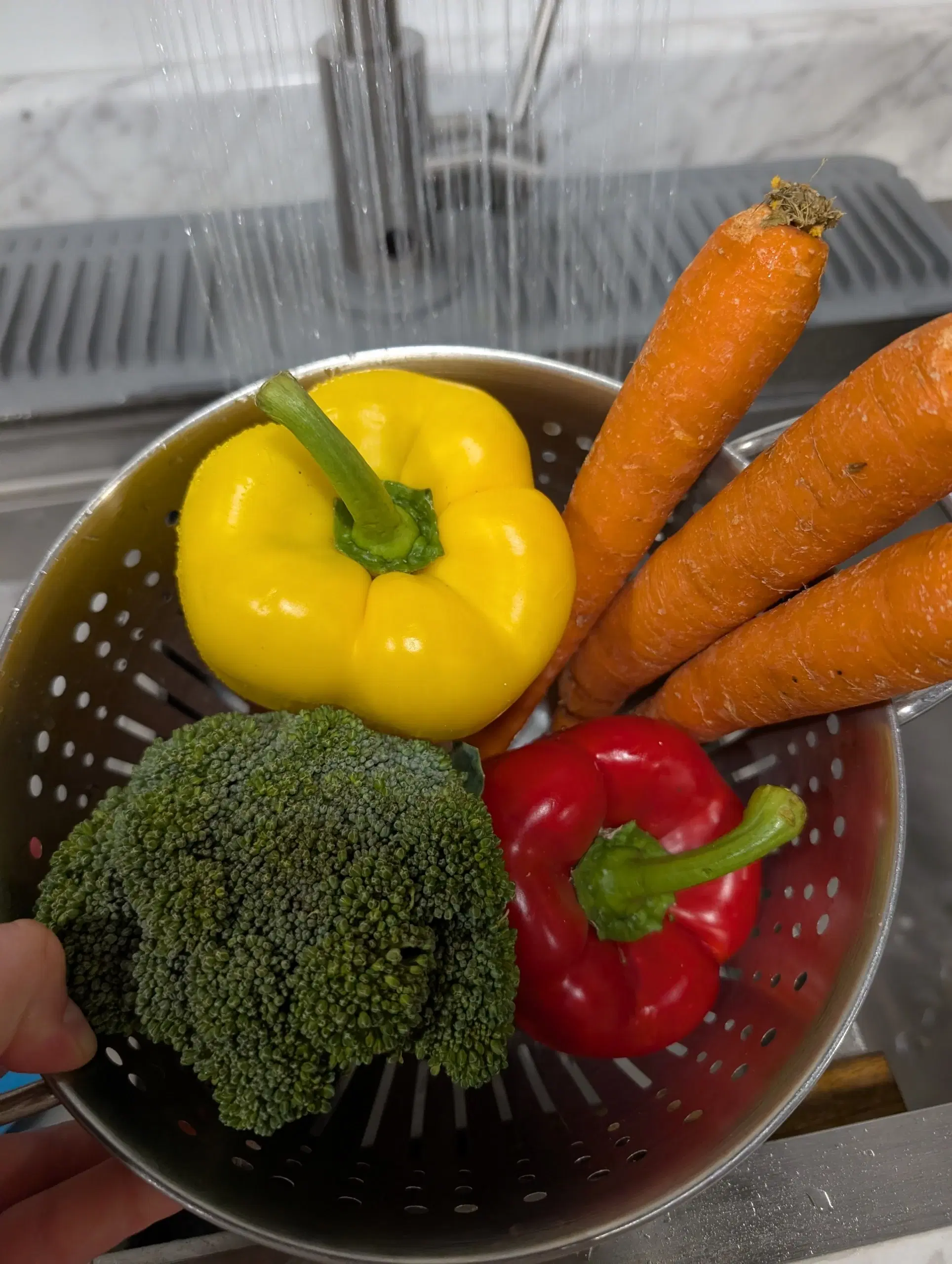
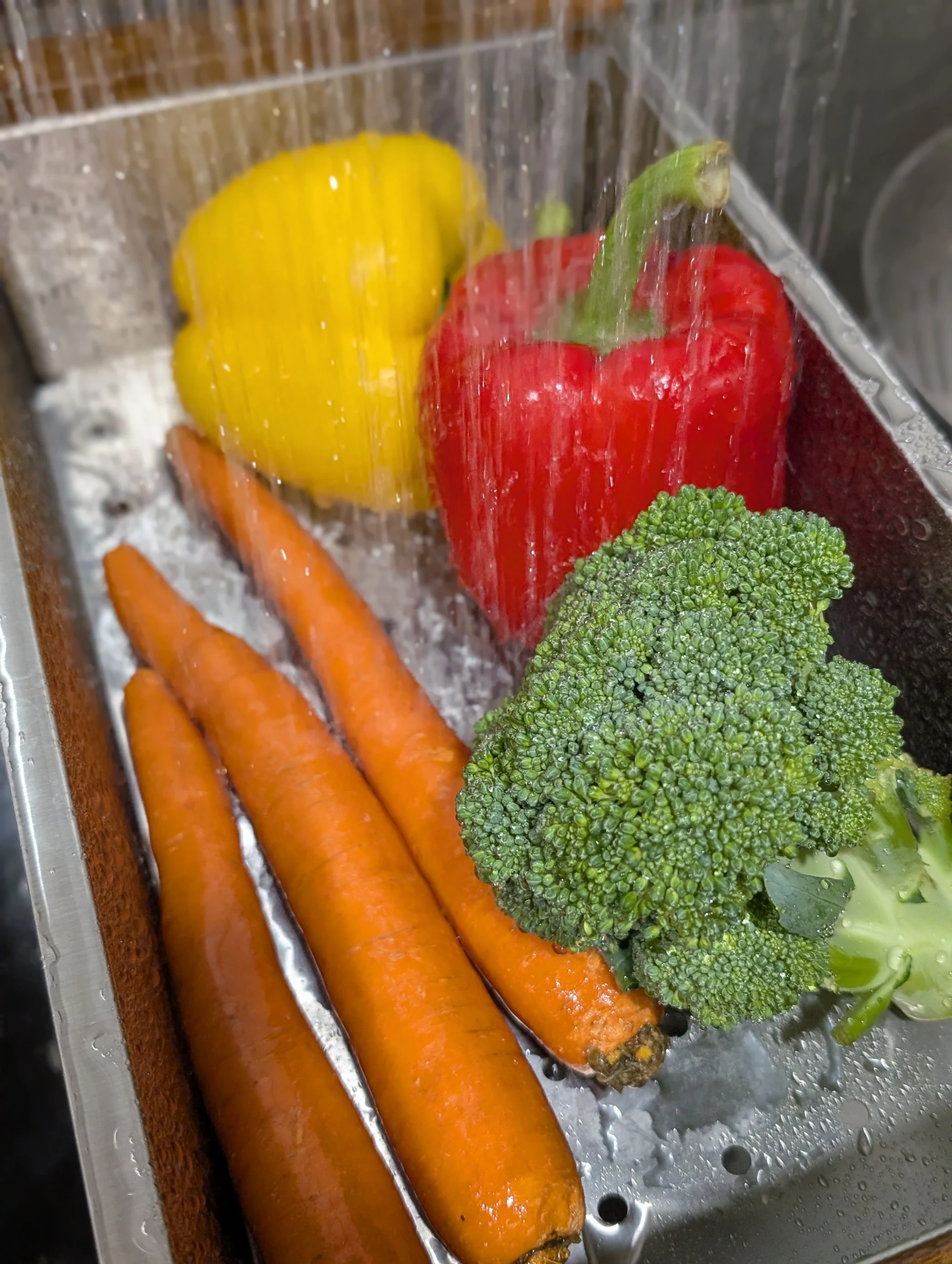
Cool running water combined with gentle rubbing removes a surprising amount of visible soil and debris.
Pesticides
If you’re buying produce from the grocery store, then you’re almost guaranteed to cross paths with pesticide residue. If there is a safe way to remove pesticide residues from our food before eating it…Why wouldn't we?
Even pesticides that have been evaluated for food use aren't something most of us are hoping to consume if we can reasonably reduce them. Especially since exposure to pesticides carries severe health risks, ranging from endocrine disruption and childhood developmental delays like ADHD to life-altering conditions such as neurological disorders and cancer (Centers for Disease Control and Prevention [CDC], 2024; National Institute of Environmental Health Sciences [NIEHS], 2024; US Environmental Protection Agency [EPA], 2024).
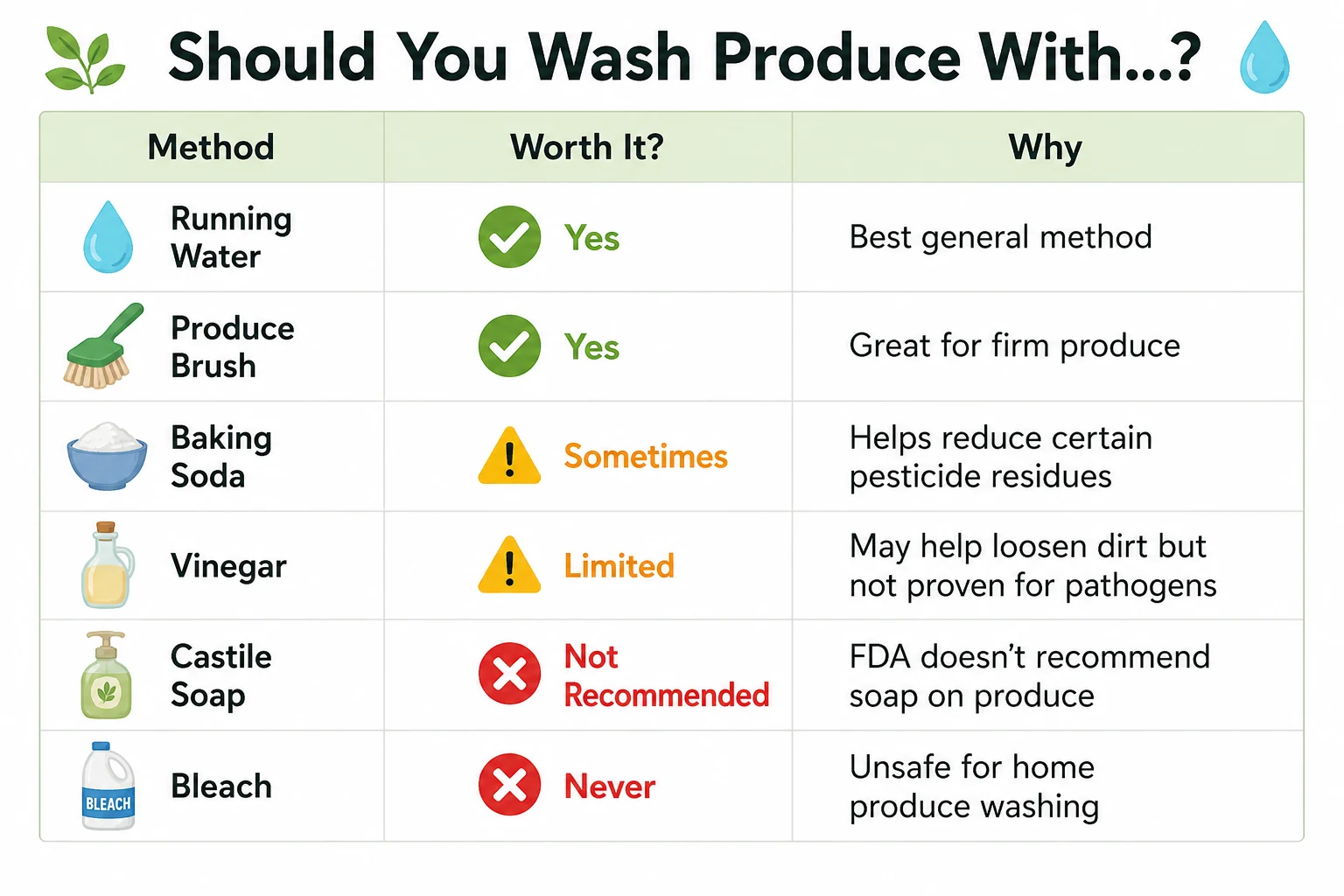
Fortunately, research has found that a simple baking soda solution can help reduce certain pesticide residues on the surface of some fruits and vegetables.
Notice the wording. It helps with certain pesticides on certain produce.
It isn't perfect but it is one of the few home methods that has scientific research behind it.
Rabbit Hole
When I worked in the food industry, I learned that deciding whether to test for contaminants wasn't always as straightforward as consumers might assume. Comprehensive pesticide testing can be expensive, and a positive result may trigger additional investigations, supplier audits, new labeling requirements (such as California Prop 65), reformulation, or even product recalls.
Because of those potential consequences—and because no single test can screen for every possible pesticide—many companies rely heavily on supplier documentation, certifications, and risk assessments instead of routinely testing every shipment. From my own experience, it wasn't unusual to see supplier statements that said something like, "To the best of our knowledge..." rather than providing analytical test results.
What About Waxes?
How to Remove Wax from Fruits & Vegetables
Most commercial produce waxes stay on the surface of the fruit or vegetable. That means they can often be reduced—or in some cases nearly removed—with a little extra effort.
Methods
Hot Water Rinse (Best for Apples & Citrus) Pour very hot (not boiling) water over the produce for about 10 seconds. You'll often see the wax turn cloudy as it softens. Immediately wipe the produce dry with a rough kitchen towel.
Baking Soda Soak (Best Overall) Mix:
- 1 tablespoon lemon juice
- 1 tablespoon baking soda
- 4 cups lukewarm water
Soak produce for about 5 minutes, then scrub firm produce with a produce brush before rinsing.
Vinegar Soak Mix:
- 1 part white vinegar
- 3 parts water
Soak for 5–10 minutes, then rinse thoroughly and scrub if needed.
Remember: Simply rinsing produce under cold water removes dirt and some microbes, but it doesn't do much to remove commercial wax coatings because they're designed to repel water.
Rabbit Trail: What's Actually In That Wax?
If you've ever wondered what grocery store wax actually is, you're not alone.
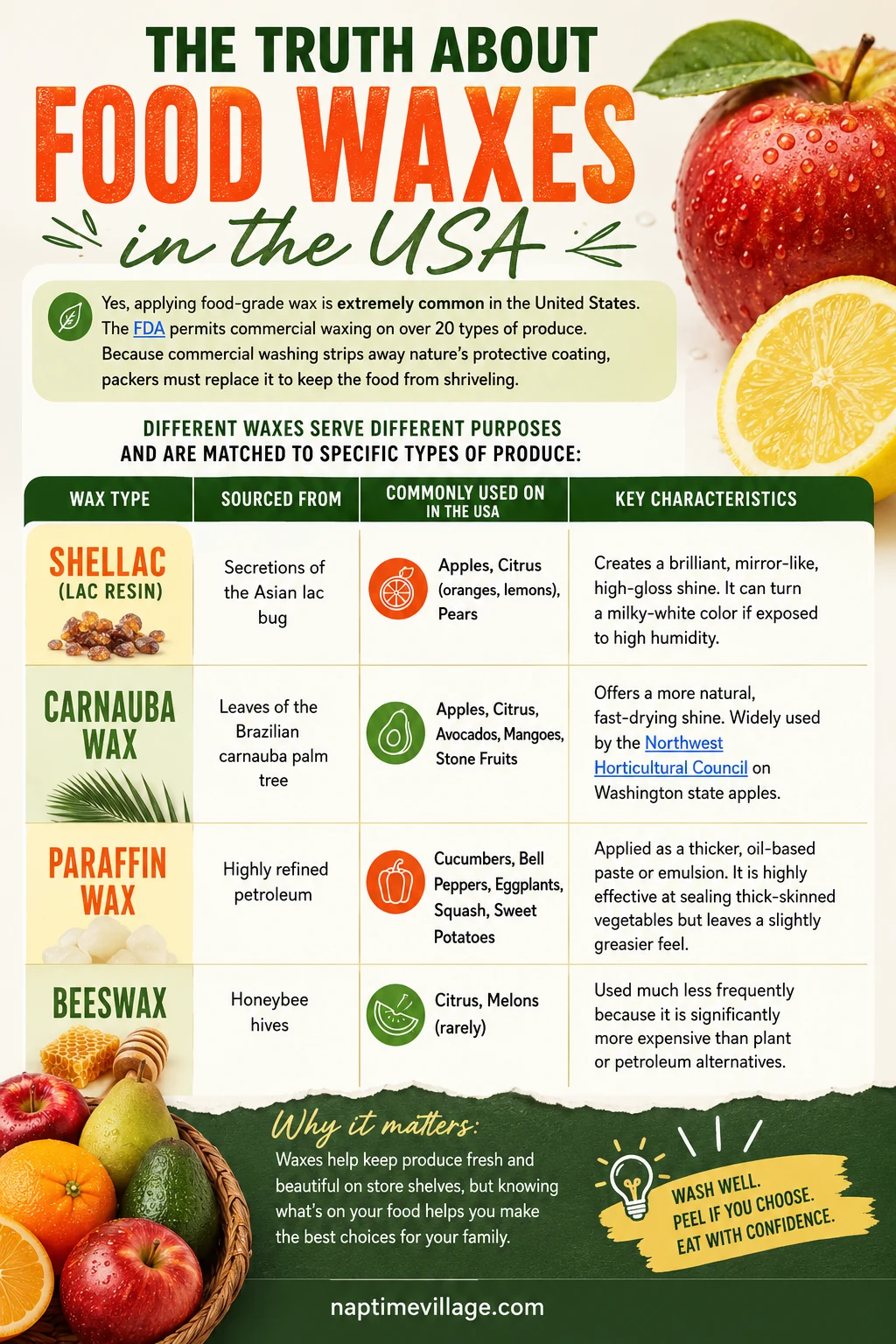
The vast majority of commercial produce in the U.S. is coated with one of three food-grade waxes:
- Shellac – a natural resin produced by the lac insect. It's commonly used on apples, citrus, and pears because it creates that shiny grocery-store finish.
- Carnauba Wax – a plant wax harvested from Brazilian palm leaves. It's another common coating on fruits and is also used in candies and pharmaceutical tablets.
- Paraffin Wax – a highly refined petroleum-based wax frequently used on vegetables like cucumbers, peppers, eggplants, squash, and sweet potatoes because it seals in moisture extremely well.
All three are FDA-approved for food use. Carnauba Wax is a GRAS item. Take that as you will.
Bacteria
Fresh produce grows outside.
That means it comes into contact with: soil, irrigation water, animals, harvesting equipment, transportation containers, and grocery store handling
Most of the bacteria on produce aren't dangerous. However, foodborne illnesses can occur when harmful bacteria contaminate fruits or vegetables. The goal of washing isn't to sterilize produce. Instead, washing physically removes many microbes along with dirt and debris. That's why rubbing the produce while rinsing matters. The physical action helps lift contamination away from the surface.
What About Cyclospora?
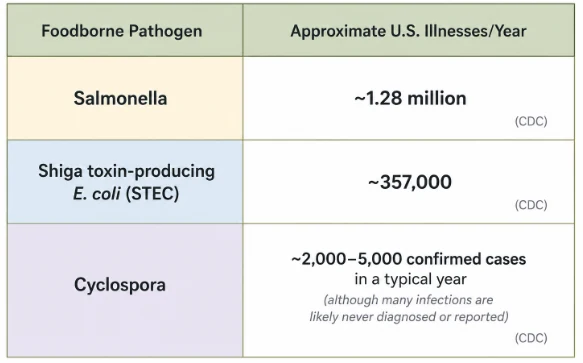
One parasite that occasionally makes headlines is Cyclospora. Unlike bacteria, Cyclospora is protected by a tough outer shell called an oocyst, which helps it survive in the environment and makes it more resistant to many of the sanitizing methods used in commercial food processing. If those microscopic oocysts become lodged in tiny creases or folds on produce, they can be especially difficult to remove. Fortunately, Cyclospora is much less common than foodborne bacteria like Salmonella and E. coli, with only a few thousand confirmed U.S. cases reported in a typicalyear.
Rabbit Trail: Wait, the food industry sanitizes produce?
I expected produce to be rinsed with water but to be “sanitized”? That never crossed my mind for fruits and veggies. Now chicken? I usually buy the cheapest and I can usually smell the chlorine when I open the package but I do have a sensitive sniffer.
Many commercially processed fruits and vegetables are washed using food-grade sanitizers like chlorine or peracetic acid (made by mixing acetic acid (vinegar) and hydrogen peroxide) before they ever reach the grocery store. Their job is to reduce harmful bacteria and prevent contamination from spreading during processing.
If you're like me, that probably isn't what you pictured when you thought of "fresh produce." Even with all of those processing steps, parasites like Cyclospora can still survive. That's one reason washing your produce at home is still recommended.
What Actually Works?
For most fruits and vegetables, food safety experts recommend:
- Cool running water (for everything besides the waxy coating-remember warm water to remove the wax)
- Gentle rubbing
- A produce brush for firm produce
- Drying with a clean towel or salad spinner
That's it.
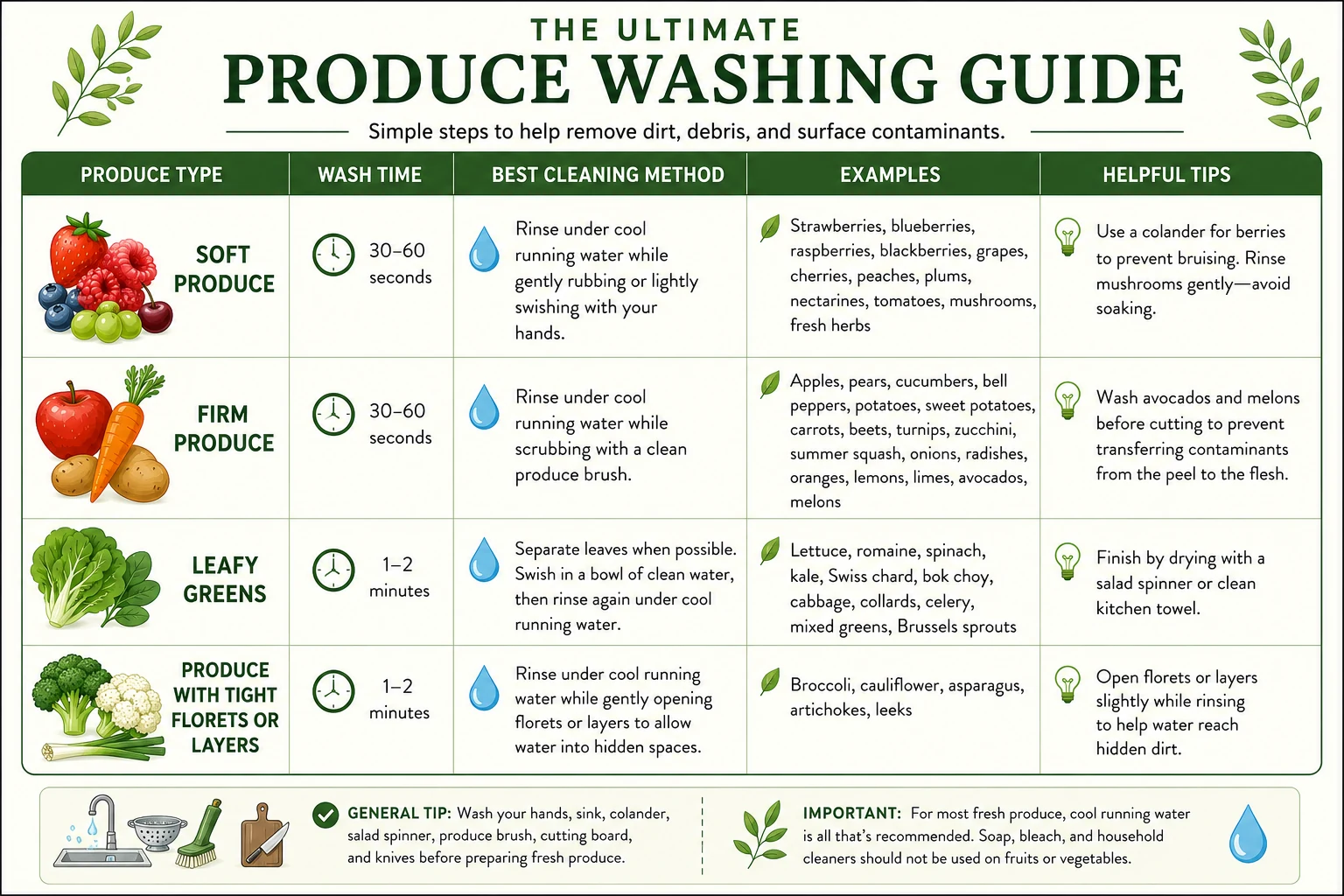
Produce Washing Routine
Step 1 Wash your hands.
Step 2 Rinse produce under cool running water while gently rubbing the surface.
- Soft produce: approximately 30–60 seconds
- Firm produce: approximately 30–60 seconds while scrubbing with a produce brush
For large batches of berries or leafy greens, separate the leaves or swish them gently while rinsing so water reaches more surfaces.
Step 3 (Optional) If you're specifically concerned about pesticide residues on firm produce, a baking soda soak is one of the few home methods with research behind it.
- 1 teaspoon baking soda
- 2 cups water
- Soak about 12–15 minutes
- Rinse thoroughly afterward
Step 4 Dry produce with a clean towel or salad spinner.
Drying physically removes additional dirt and microbes.