Article contents
Contains Affiliate Links
This Chore Card idea came about because my daughter is getting to an age where she can really help with certain chores around the house.
She's your typical firstborn. She's also a fairly compliant child, so she's willing to do a lot of the things I ask of her. And as the oldest of four kids, I just didn't want her to ever feel like she was being taken advantage of simply because she's the oldest and the most capable.
I don't want her looking back in adulthood and thinking, Mom made me do all this stuff for her, and resenting me—or resenting coming from a bigger family—because she was always the one expected to help.
At the same time, I absolutely think kids should help around the house simply because they're part of the family. We all live here. We all make messes. There are plenty of things we do together because that's just part of being a family.
But there are also times when what I'm asking her to do is genuinely helpful to me. It's something I need to get done around the house that while it may only take me 5 minutes to do, if I don’t have to stop and do it while in the middle of making dinner it’s super helpful to have her help!
Those are the type of jobs I tend to reward.
What Counts as a "Chore" in Our House?
These aren't necessarily consistent daily chores. They're more like those special instances when her help genuinely makes my life easier.
For example, I like to back my van into our basement walk-in area when I get home. The problem is, that's also a very convenient place for kids to leave all kinds of yard toys—my son's tricycle, my daughter's balance bike, and who knows what other little yard toys might be lined up there that day.
So when I'm packing everyone up to go somewhere and I know I'll want that space clear when I get home to drop off some grocery items, I'll ask my oldest to go pick everything up before she gets herself into the van and buckled. I could ask the toddlers to do it but in the moment when I’m trying to get out the door, having two kids buckled in carseats is more important than asking them to clean up their toys.
She'll run over and move the toys for me, and then when I get home, I can just back the van in without worrying about toys being in the way.
That's a square. In fact, on a grocery day, it's very possible she'll earn two or three squares.
Sometimes she'll help me get shoes on one of the younger kids or help get a younger sibling dressed, which is a huge help to me when I'm trying to get four kids out the door.
Then, when we get home with groceries, she might stay with the baby, entertain him, and keep him happy while I carry everything inside.
That's another square.
Another example is their bedroom. During this season of life, all of my older kids share a room, and my firstborn happens to be the neat and tidy one. Her things are usually fairly well picked up, but her siblings' things aren't always.
I have the younger kids do as much as they can, but sometimes she does that final pickup so I can get in there and vacuum—or she might vacuum it herself. Because she's cleaning up things that weren't necessarily hers to begin with, I give her a square for helping me.
Those are the kinds of things I'm talking about.
They're not necessarily her responsibilities. They're little jobs that take something off my plate and make getting through the day with four young kids a little easier.
And I want her to know that I notice and appreciate that help.
She Can Say No
Something else that's important to me is that I ask her to do these extra jobs.
She has the option to say yes or no.
These aren't things I'm forcing her to do. They're things that are helpful to me.
I'm the adult, and I'm the mom. There are responsibilities that I chose as an adult and as a mom, and I try to be very careful about automatically making those responsibilities my oldest child's responsibilities simply because she's old enough and capable enough to help.
Caring for younger siblings is a good example.
I absolutely think there's value in kids learning to care for and help one another. We're a family, and helping each other is part of that.
But I also don't want my daughter to feel like she's missing out because I'm asking her to help with a baby. I don't want her to feel like caring for her younger siblings became her responsibility simply because she happened to be born first.
Most of the time, that's not the case at all. She's perfectly happy to help.
So I might ask, "Hey, would you sit with the baby and entertain him while I bring in the groceries?"
She can say yes or no.
If she says yes, that's a square. If no, that’s fine too.
It's a small distinction, but it's an important one to me.
I'm not paying her to be a member of our family, and I'm not making her responsible for my responsibilities. I'm rewarding her when she chooses to give me some extra help.
Not Everything Earns a Square
And not everything she does earns a square.
If we're saying, We're going to clean this as a family because we all use this space, I'm less likely to make that a Chore Card thing.
There are also absolutely days when my daughter will say, "Well, I did this! Can I get a square?"
And sometimes the answer is no because it doesn’t need done or it’s really just because she wants to color in a square for fun.
I'll just say, "No, that's not something we're going to get a square for."
For my child, that's an acceptable answer for now. I don't know how it'll work with my other children as they get older!
The goal isn't for her to expect to be paid every time she picks something up or does something that's simply part of being in our family.
This is really more of a Mommy's Helper type of thing.
It's a way for me to recognize the times when she's doing something extra that is genuinely helpful to me.
Maybe "Helper Card" Is Actually a Better Name
As we've used this system, I've realized that some of the things my daughter earns squares for aren't really "chores" at all. A lot of the time, she being my helper. But I also know that other families may want to use these cards very differently.
Maybe you do want a traditional chore system. Maybe you want your child to complete certain jobs throughout the week. Maybe you're looking for something to use instead of a traditional allowance. Or maybe you're more like me and want a simple way to reward those little extra jobs that genuinely help you.
So I'm keeping the Chore Card as the main printable, but I've also created several Helper Card versions.
There is a:
- Chore Card
- Helper Card
- Mommy's Helper Card
- Daddy's Helper Card
- Grandma's Helper Card
- Grandpa's Helper Card
- Teacher's Helper Card
They all work essentially the same way. You decide what earns a square, and you decide what happens when the card is complete.
I really like having the different titles because this doesn't have to be exclusively a "Mom chore system." Grandma can have jobs the grandkids help her with. Dad might have projects outside or in the garage. A teacher might have little classroom jobs that genuinely make her day easier.
Or maybe you don't want to attach anyone's name to it at all. That's what the generic Helper Card is for. Also, depending on the integrity of your child, you may want to skip laminating these cards as I suggest later on and use a hole punch. That’s a lot harder for kids to “make up” chores/tasks they didn’t do.
Why 20 Squares?
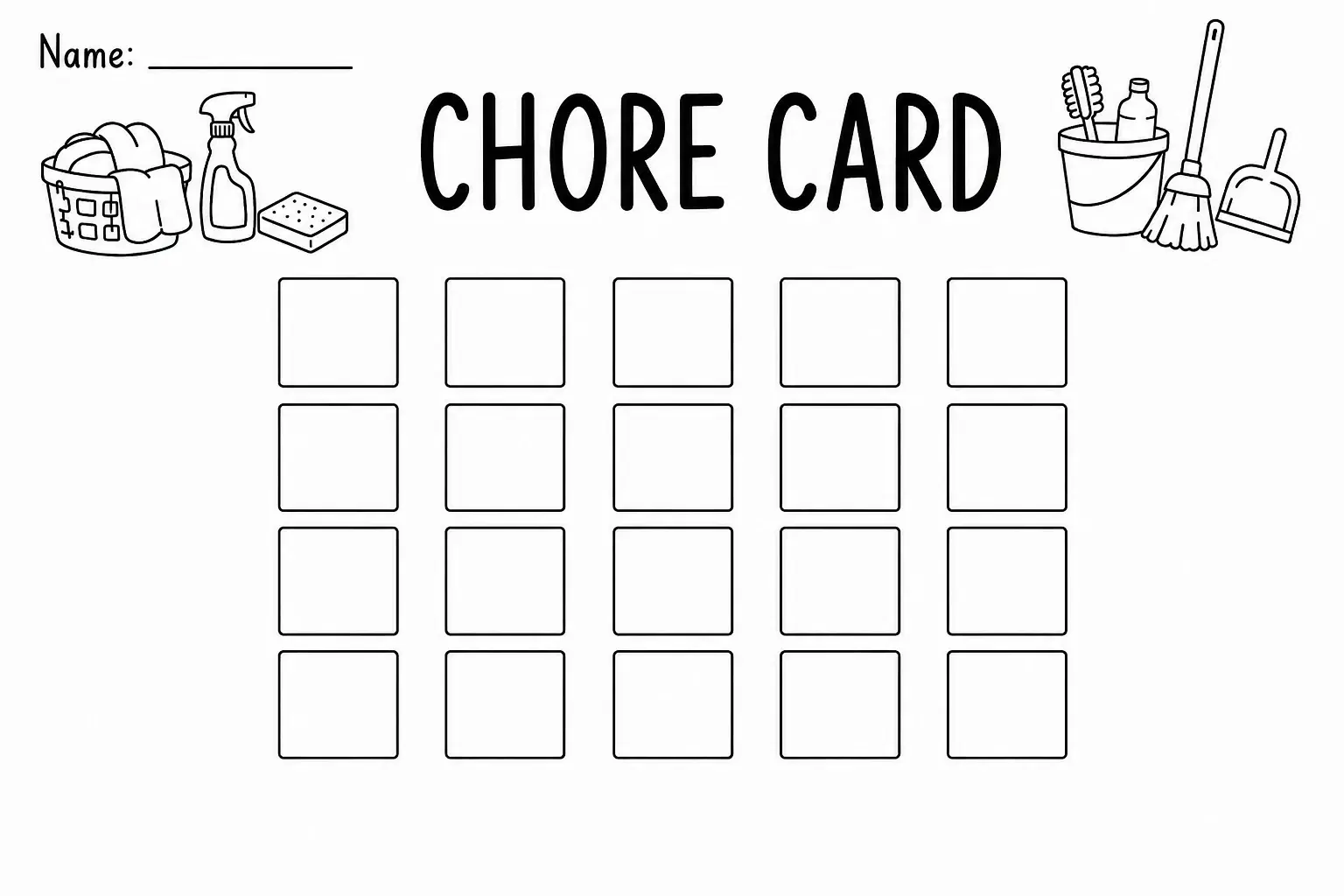
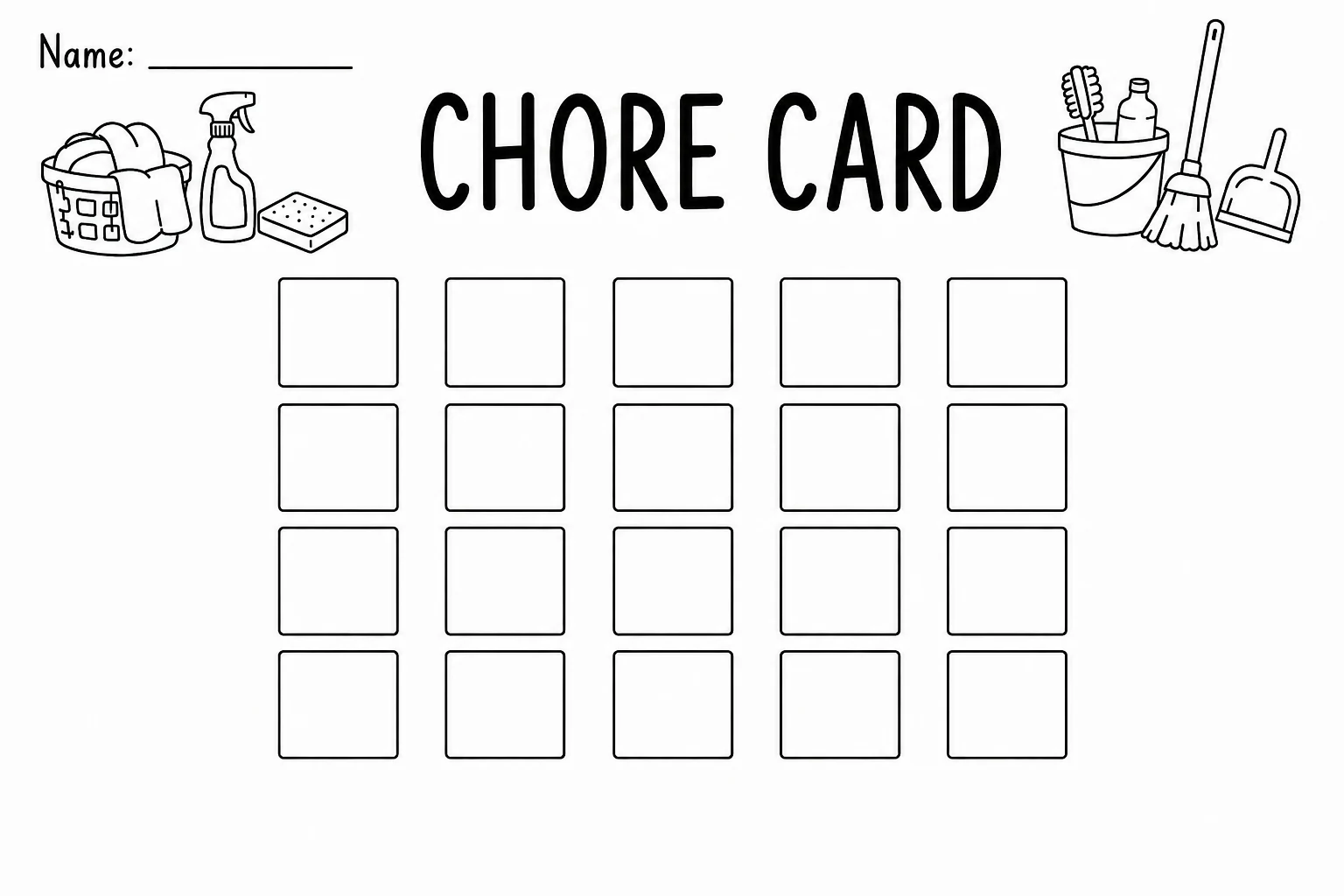
My updated card has 20 squares. For our family, each square is worth 25 cents. As seen in the pictures I tried the 15 squares but we were filling that up quickly and I wanted to work in more money terms so now we’re using 20 squares but I haven’t updated my images yet- full disclosure here on Naptime Village. I do have the 15 square version available here if you would rather use that.
So: 20 squares × $0.25 = $5
Once she fills the entire card, she's earned $5. To me, 20 helpful jobs for $5 isn't outrageous, but $5 is still enough money that it actually means something to a young child.
I also like that 25 cents per square is really simple. Eventually, she can begin to understand that every time she earns another square, she's earned another quarter. All of those little jobs slowly add up until she reaches $5.
But what I really like is what happens after she fills the card. She worked to earn that $5 in the first place. Now she has another choice. Does she spend it, or does she save it?
If there's something she wants that costs $10, she needs to complete two cards. If she wants something that costs $15, she needs to complete three. If she wants something that's $20, that's four completed cards.
So without turning this into some big formal lesson on money, she's learning:
Work → Earn → Save → Buy
Your Chore Card Doesn't Have to Be Worth $5
Of course, you absolutely do not have to use our system.
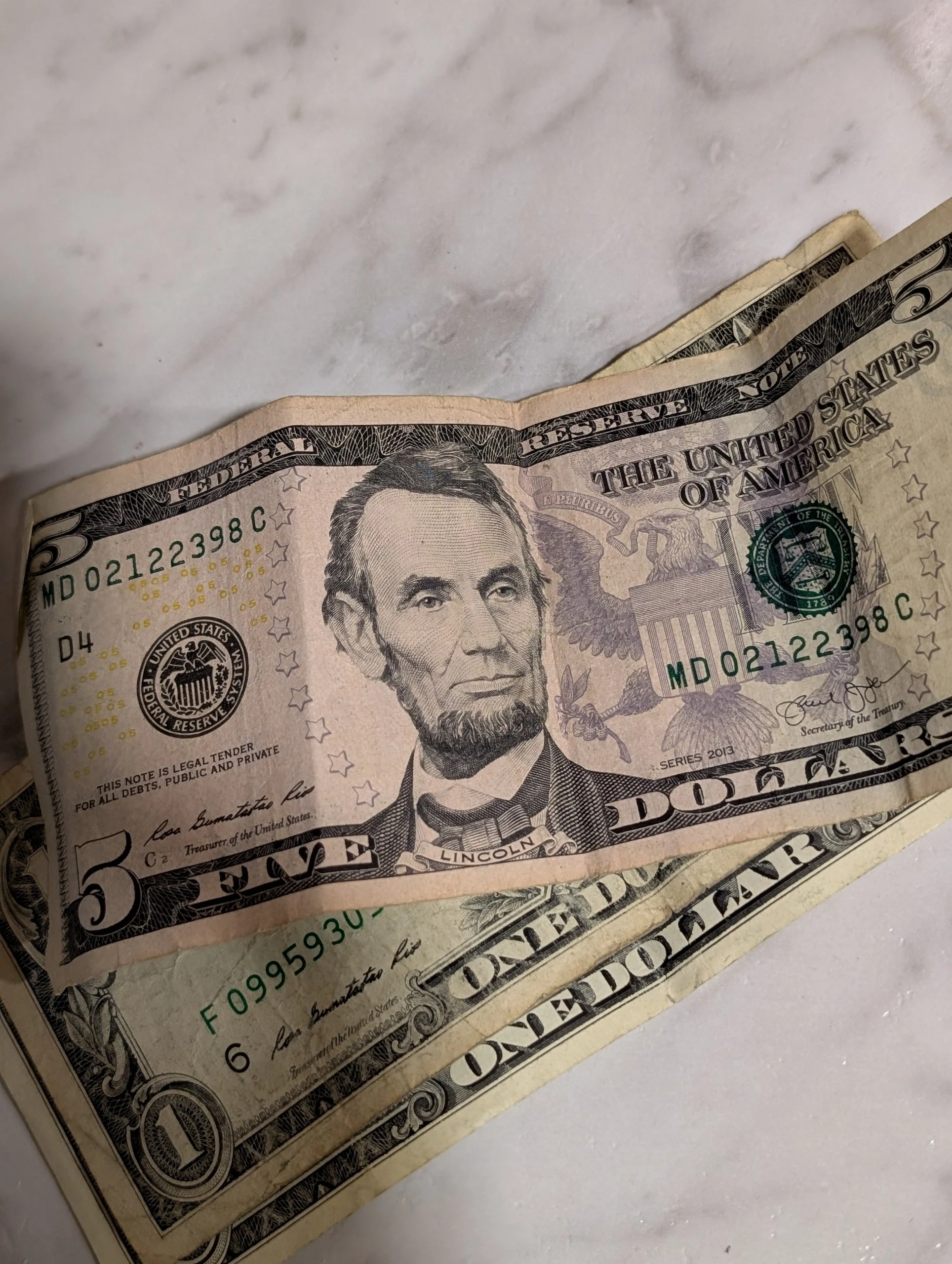
That's actually why I didn't put "$5" or "25¢" anywhere on the printable itself.
I'll let you as the parent decide: What's the reward, and what does your child have to do to get that reward?
Maybe a completed card is worth $5. Maybe it's $1. Maybe your child gets to pick something out of a prize basket. Maybe it's a little toy or trinket. Maybe it's an experience, a special privilege, or something completely different.
The card is just a visual way to keep track of it. How I Print and Prepare Our Chore Cards
You don't need anything fancy to use these Chore Cards. You can print them on regular printer paper or cardstock, cut them out, and laminate them using a regular letter-size laminating pouch. If that's what you already have at home, use it!
But because I make enough of these little systems for our house and laminate quite a few things for homeschooling, too I keep some of the more specific sizes on hand.
Printing the Cards
For these, I like using Avery 5389 4×6 postcard sheets. They're already the right size for the 4×6 Chore Cards, so I don't have to print them on a full sheet of paper and then cut each card out.
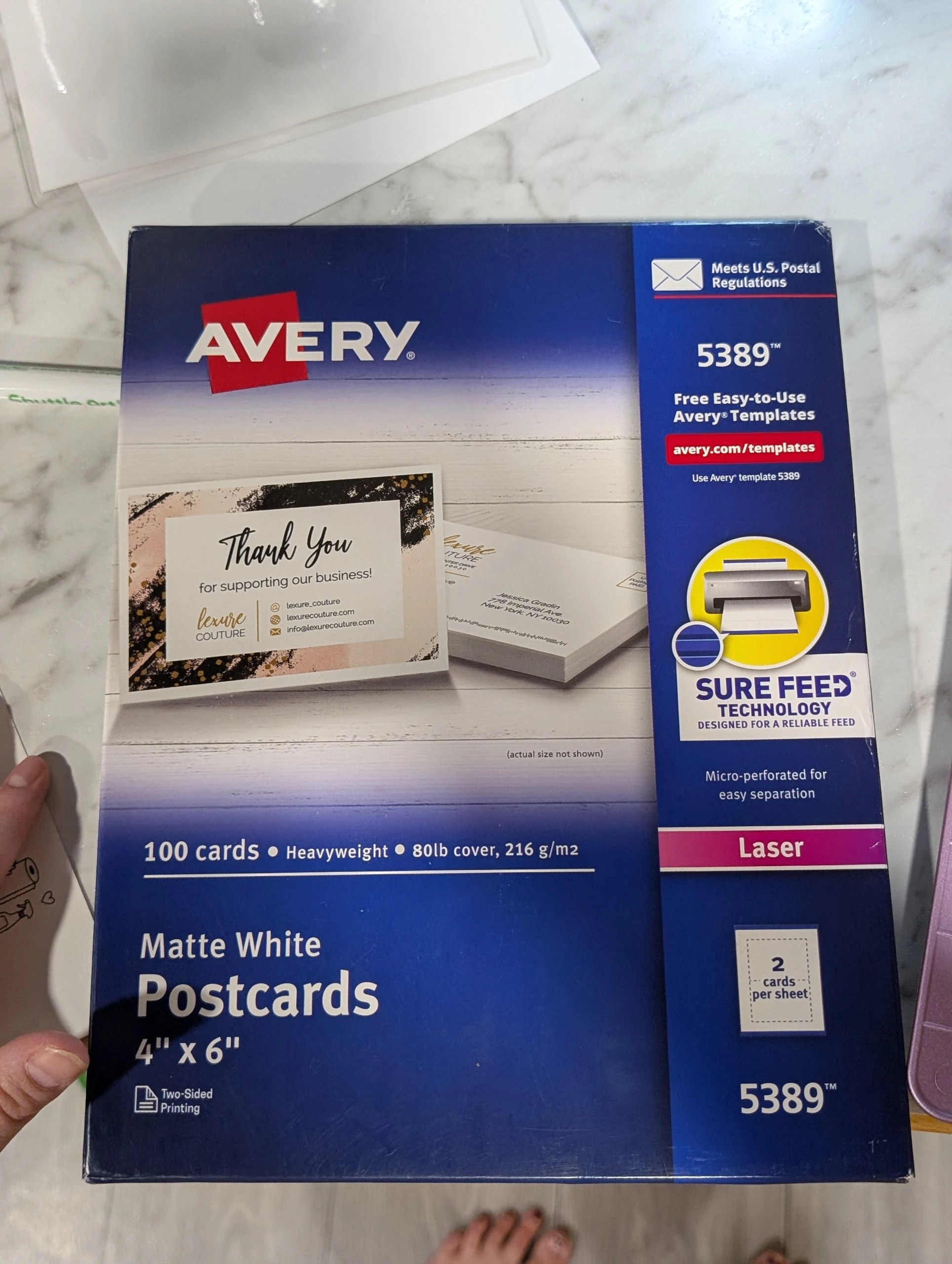
Again, you absolutely don't need these. Regular paper or cardstock works just fine. Print the card, cut it down to 4×6, and you're ready to laminate.
Laminate Your Chore Card
Once my cards are printed, I laminate them.
I use a 13” Laminator Machine, and this is one of those things I use for way more than just this project. Between little systems like these Chore Cards and all of the things I laminate for homeschooling, mine gets plenty of use around our house. It also has a paper cutter which is convenient.
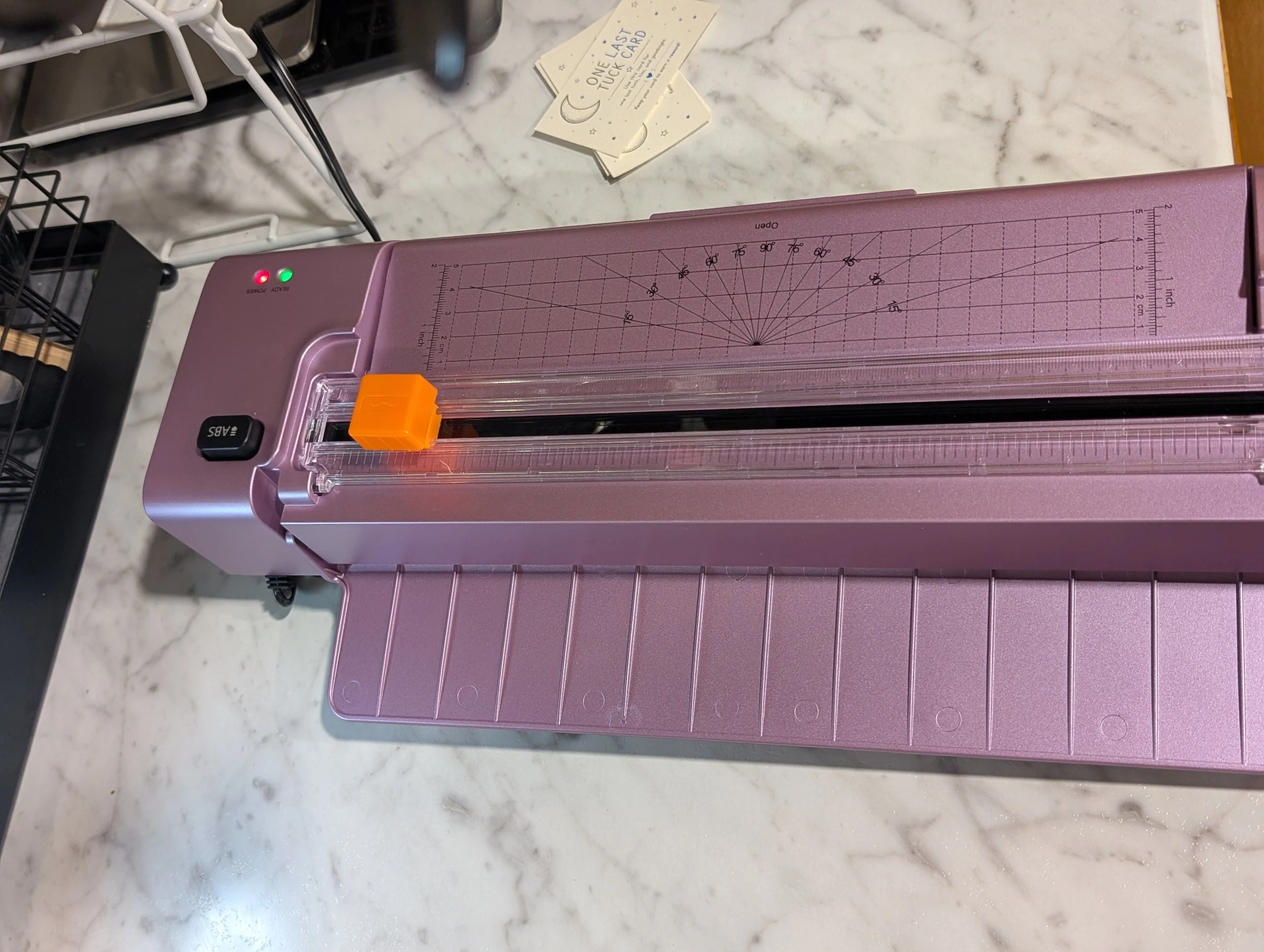
For these particular cards, I also like using 4×6 laminating pouches. Since I make enough 4×6 printables and little reusable systems, it's convenient for me to keep this size on hand.
But please don't feel like you need to buy special laminating pouches just for this! If you already have regular letter-size laminating pouches, use those. You can laminate the card with what you already have and simply trim around it- or don’t laminate at all. Just print out a new card every time if that’s easier.
Use Wet-Erase Markers, Not Dry-Erase
The one thing I do recommend is using a wet-erase marker instead of a dry-erase marker on your laminated Chore Card.
Dry-erase markers wipe away a little too easily for this particular system. These cards are going to be picked up, moved around, handled by kids, and probably tossed on the counter a time or two. I don't want a child to earn a bunch of squares only to have them accidentally rubbed off!
Wet-erase marker still comes off the laminated card, but it doesn't wipe away nearly as easily. When the card is full, wipe it clean with a damp cloth and start again.
In a nutshell:
Print → Laminate → Fill in the squares → Earn your reward → Wipe it clean → Start again.
As an Amazon Associate, I earn from qualifying purchases.
The Master Chore List
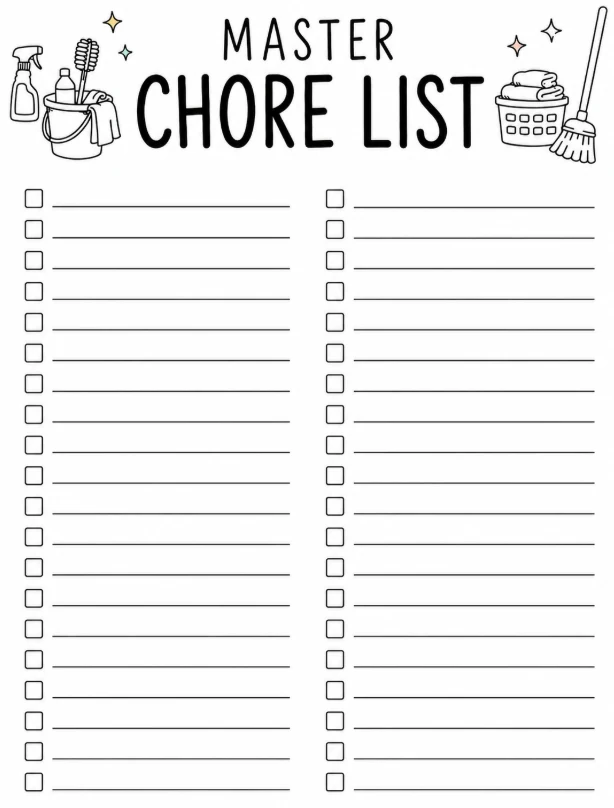
I've also included a Master Chore List that you can laminate and hang on your refrigerator.
I intentionally made this one open-ended. Every family has different jobs that need to be done, and every child has different things they're capable of doing.
An older child who can read and work more independently could look at the Master Chore List and see which jobs are available. My daughter isn't quite at that point yet.
There are certainly things we could put on a list for her, but right now I think she still needs some more visual cues and for me to actually tell her what would be helpful. As she gets older, I can see the Master Chore List becoming more useful for us, too.
Keep It Simple
I really don't want this to become one more complicated system for Mom to manage. That's kind of the opposite of the point.
This came from me needing help with the everyday things that come with raising a family and realizing that my oldest was getting old enough to genuinely be that help sometimes. I wanted a way to acknowledge that. I wanted her to know that I noticed when she went above and beyond what was expected of her. And I wanted to be careful that being the oldest didn't automatically mean she became responsible for things that weren't actually her responsibility.
For us, the Chore Card has been a really simple way to find that balance. And your version doesn't have to look exactly like ours. Print the card you want. Decide what earns a square. Decide what happens when all 20 squares are full. And go from there.
Thanks for reading!
The Naptime Village Mom